Why does a Freddo cost 45p?
The Freddo was 10p for thirteen years. Cadbury itself now charges 45p, and cocoa only explains about 3p of the journey. A chocolate frog's guide to where your money went.

Jordan Walker

Cadbury's own website will sell you a single Freddo for 45p, and that number is doing more economic storytelling than most textbooks manage in a chapter.
The Freddo was relaunched in the UK in 1994 at 10p, and it stayed at 10p for thirteen years. For a generation of British schoolchildren it was the unit of account that mattered. Pocket money was measured in Freddos. Then, in 2007, the price started moving, and it has never stopped: 15p, then 20p by 2011, 25p by 2019, 35p on price-marked packs from March 2025, 39p on those packs by August 2026, and 45p if you buy one today from Cadbury Gifts Direct, the manufacturer's own shop.
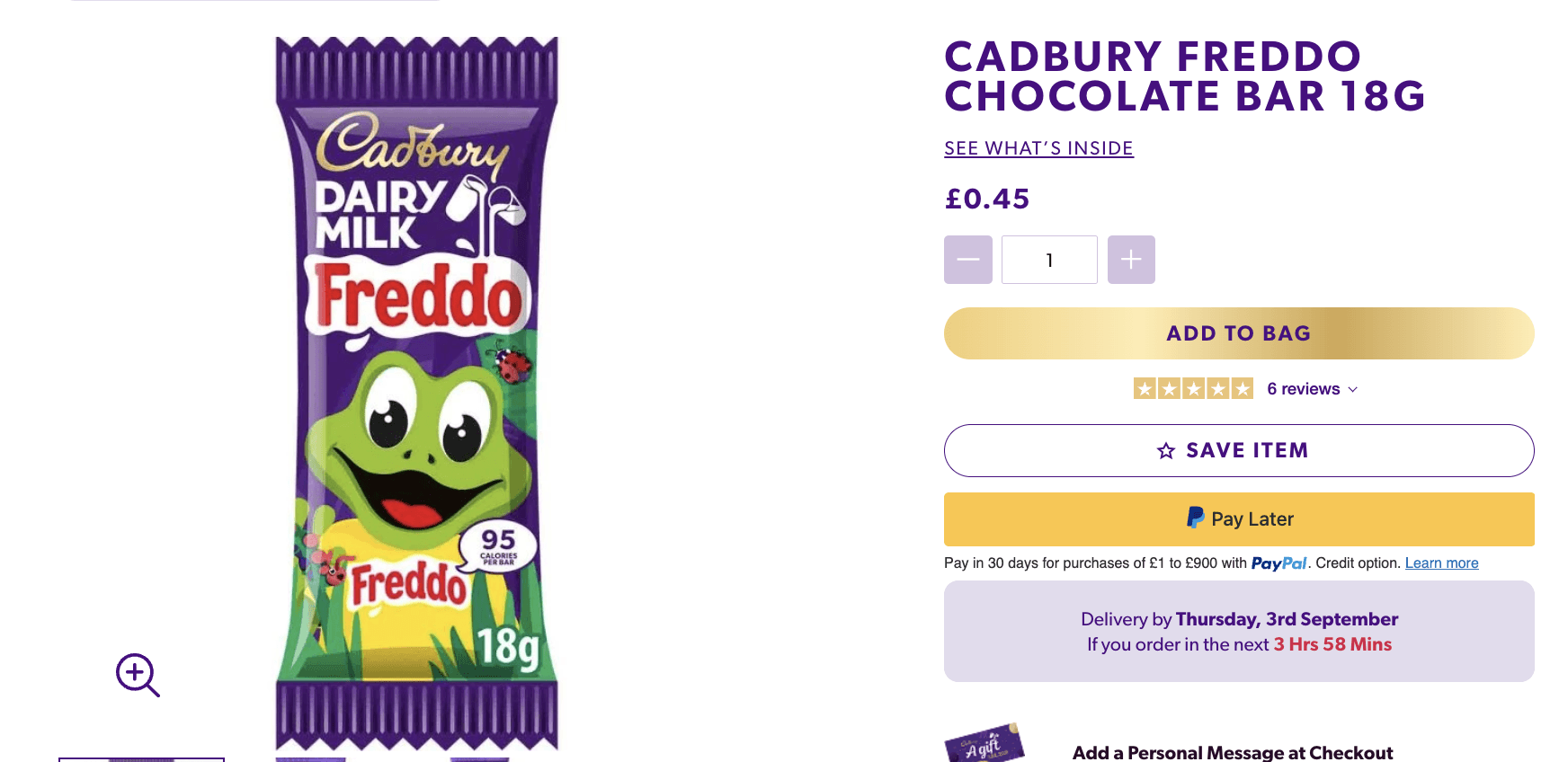
That is four and a half times the original price for a bar that is still the same 18 grams of frog it always was.
So who took your 35p? The honest answer is that two different things happened to the Freddo, and almost everyone merges them into one word, inflation. Separating them is where this gets interesting.
Suspect one: the pound got smaller
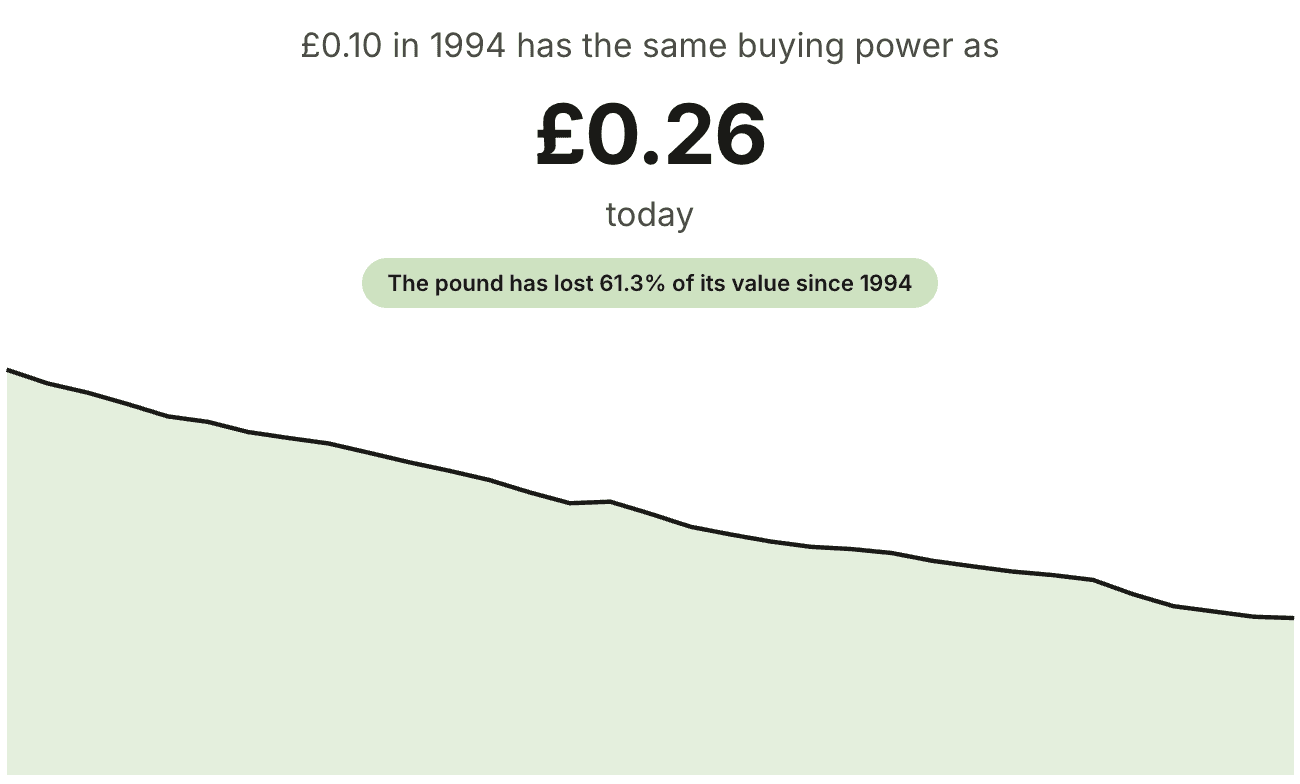
Start with the boring, permanent force. Run 10p from 1994 through our purchasing power of the pound tool and it comes out at 26p today, because the pound has lost 61.3% of its value over those three decades. The government's official CPI measure is stingier and puts the same journey nearer 22p. The gap between those two answers is itself instructive, since even the official measuring sticks cannot agree on how much the pound has shrunk. But take either number and the story is the same: if the Freddo had done nothing except keep pace with inflation, it would cost somewhere in the mid-20s today.
That journey from 10p to the mid-20s has nothing to do with frogs, cocoa or Cadbury. It is the same force that took a pint, a stamp and a bus fare upward over the same three decades, and the frog's price rose to compensate. The tool is the Freddo chart with the chocolate removed, and you can run it on anything you like.
But even the generous measure only gets you to 26p. Cadbury wants 45p. Something else has been eating the difference.
Suspect two: the cocoa crisis
In late 2023, the cocoa harvest in West Africa began to fail. Côte d'Ivoire and Ghana grow around 60% of the world's cocoa between them, and a run of bad weather and crop disease hit both at once. The result was one of the sharpest commodity spikes in modern history. Cocoa futures, which had spent decades trading below their 1977 record of roughly $5,100 a tonne, blew through it in early 2024 and peaked near $12,500 a tonne on the ICE exchange in December 2024.
Chocolate makers responded the way you would expect. Mondelez, which owns Cadbury, cited "significantly higher input costs" as it repriced across the range. The Freddo's price-marked packs moved to 35p in March 2025. The multipacks did something sneakier: the five-bar pack became a four-bar pack at the same £1.40, which works out at a jump from 28p to 35p per frog without the shelf price changing at all.
Here is the part worth sitting with, though. How much cocoa is actually in a Freddo?
An 18 gram bar of Dairy Milk chocolate contains roughly 4 grams of cocoa. Run the rough numbers and even at the absolute peak of the worst cocoa crisis in a generation, the raw cocoa inside one Freddo cost somewhere around 4p. Before the crisis, it was closer to 1p. The most dramatic commodity spike in decades explains perhaps 3p of the frog's journey.
The tell: cocoa crashed, the Freddo didn't
Then came the twist. Harvests recovered, demand softened, and cocoa collapsed. By March 2026 futures had fallen to around $2,850 a tonne, down more than 70% from the peak and back to late-2023 levels. The commodity emergency was, for a while at least, over.
The Freddo's response to this good news was to go up another 4p, reaching 39p on price-marked packs by August 2026.
This is the pattern economists politely call price stickiness and the rest of us recognise from every shop we have ever stood in. Prices follow costs up with enthusiasm and follow them down almost never. Part of that is legitimate: manufacturers hedge, so they were still working through cocoa bought at crisis prices, and dairy, energy, wages and packaging all cost more too. But a large part of it is simpler. Once a price has moved, the shrinking pound underneath it makes sure it never needs to move back. The debasement force from suspect one keeps ratcheting, so every temporary cost shock gets locked in on the way through.
That is why your instinct that "everything only ever gets more expensive" is not paranoia. It is two forces working a one-way ratchet: commodities push prices up in bursts, and the slow leak in the currency holds each new level in place.
What the frog teaches you about money
The Freddo is a 30-year controlled experiment. Same recipe, same 18 grams, same frog. The only thing that changed dramatically is the measuring stick, the pound, plus one genuine cocoa shock that explains far less of the price than most people assume.
This is where Bitcoin enters the story, not as an investment tip but as a contrast in design. The pound's supply is elastic: the Bank of England and the banking system can expand it, and over 30 years that expansion shows up as a chocolate frog quadrupling in price. Bitcoin's issuance schedule is fixed in its code, capped at 21 million, with no committee able to revise it. Whether that makes it good money is a genuinely open question, and its price in pounds swings hard over short periods, far more than anything discussed in this article. But it is the first widely held asset in history where the measuring stick itself cannot be stretched, and the Freddo is a 45p argument for why that property is worth understanding. If you want the from-scratch explanation, start with WTF is Bitcoin.
None of this is financial advice. It is a chocolate frog, a calculator, and a question worth asking about everything else on the shelf.
If you enjoyed working out where your 29p went, the weekly newsletter does this to a different price tag most weeks.
FAQ
How much does a Freddo cost in 2026? It depends where you buy it. Supermarket singles start around 34p, price-marked packs show 39p as of August 2026, up from 35p in March 2025, and Cadbury's own gift website sells a single bar for 45p. Multipacks work out cheaper per bar.
How much did a Freddo cost originally? The Freddo was relaunched in the UK in 1994 at 10p and stayed at that price until 2007.
Why did chocolate get so expensive in 2024 and 2025? Failed harvests in Côte d'Ivoire and Ghana, which grow around 60% of the world's cocoa, drove cocoa futures from under $3,000 to nearly $12,500 a tonne by December 2024. Prices have since fallen back sharply, but chocolate on the shelf has largely kept its crisis-era pricing.
Has the Freddo shrunk as well as gone up in price? The single bar is still 18 grams. In 2025, however, Cadbury reduced the Freddo multipack from five bars to four while the pack price stayed at £1.40, a 25% rise per bar with no change on the shelf label.
What would a Freddo cost if it had only tracked inflation? Somewhere between 22p and 26p, depending on the inflation measure used. Official CPI data since 1994 gives around 22p, while broader measures of the pound's lost purchasing power give around 26p. The gap from there to 45p is the combination of the cocoa shock, other input costs, and prices ratcheting rather than falling back.
About

Featured Posts


Explore Topics


