Premium Bonds: why winning still feels like losing
22.7 million people hold Premium Bonds and nearly two-thirds have never won a penny. The advertised rate is an average that hides what most people actually get: nothing.

Jordan Walker

Two people become millionaires on the first working day of every month. Neither of them is you.
That is the quiet magic of Premium Bonds. Around 22.7 million people in Britain hold them, more than hold any other single savings product. Between them they have parked over £134 billion with National Savings and Investments, the Treasury-backed bank behind the scheme. Every month a machine called ERNIE picks winning numbers, and every month almost everyone wins nothing.
Here is the part that stings: nearly two-thirds of Premium Bond holders have never won a single prize.
That figure comes from a Freedom of Information request the investing app Dodl, run by AJ Bell, put to NS&I in 2025. Just under 14.4 million people, out of the 22.7 million who hold bonds, have never had a penny back.
So how does a savings product that pays most of its customers nothing stay the most popular in the country? The answer is a lesson in how averages lie, and a decent way to understand what "return" even means.
The short answer
The advertised rate on Premium Bonds is not what most people get. It is an average, and the average is dragged upwards by a tiny number of enormous prizes almost nobody wins.
The honest number, the one that describes a typical holder, is much lower, and for most people it is zero.
How the machine actually works
Premium Bonds do not pay interest. You buy bonds at £1 each, up to a maximum of £50,000, and each bond is a ticket in a monthly draw. Win, and the prize is tax-free. Lose, and you keep your money, which you can withdraw whenever you like. Your capital is safe because the Treasury stands behind it.
NS&I describes the scheme with a "prize fund rate." From the July 2026 draw that rate is 3.80%. The odds of any single £1 bond winning any prize in a month are 22,000 to 1.
The prize fund rate is where the trouble starts, because it sounds like an interest rate and it is not. It is the total prize pot expressed as a percentage of all the money held. In July 2026 that pot was an estimated £436.8 million, spread across 6.27 million prizes, which sounds generous until you look at how those prizes are shaped.
Follow one month of prizes
Take the official NS&I breakdown for the July 2026 draw. Of the 6.27 million prizes:
2 are worth £1 million
83 are worth £100,000
167 are worth £50,000
Nearly 6.2 million, the overwhelming bulk, are worth £25, £50 or £100
The two £1 million jackpots alone account for £2 million of the pot. A handful of holders take home life-changing sums. The rest of the pot is sprinkled in £25 pieces across the country.
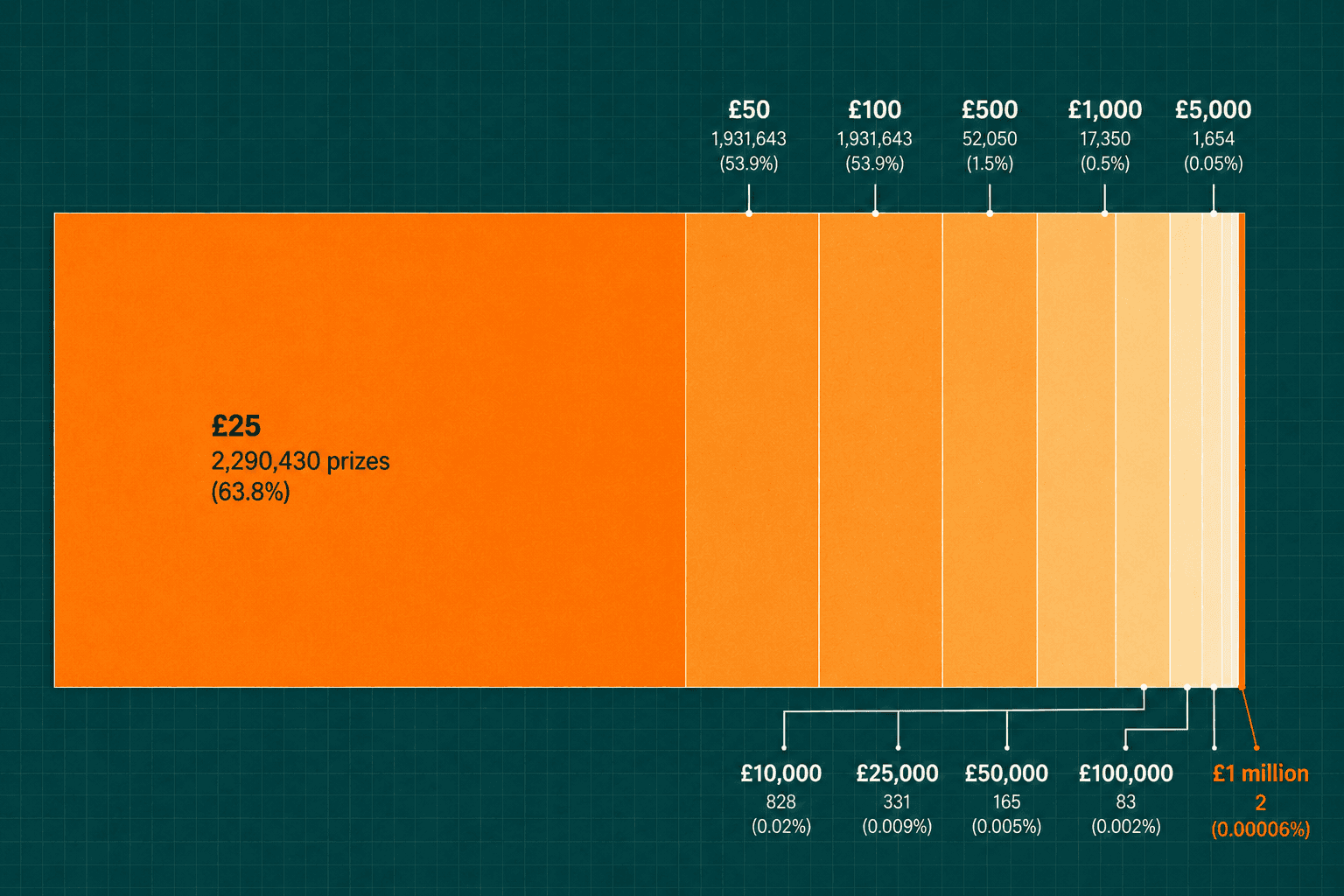
Now think about what that does to the average. Imagine selling a million people a £1 raffle ticket and paying one winner £1 million. You could say, truthfully, that the average payout was £1, so on average everyone broke even. That would also be nonsense, because almost everyone got nothing.
Premium Bonds are a gentler version of the same maths: the mean return is 3.80%, but the typical return, the one experienced by the person standing in the middle of the queue, is far lower.
What a typical holder actually wins
The number that matters is the median: line every holder up from worst luck to best, and look at the one in the middle.
For a small holding, the median annual win is zero. Independent probability calculators, using NS&I's own published odds, put the median return on £1,000 of bonds at £0 in a typical year, which is not a low number but nothing at all.
You need a large holding before the law of large numbers starts to rescue you. At the full £50,000, a holder with median luck wins roughly £1,625 over a year at the current rate, which works out at about 3.4%, close to but still below the headline 3.80%. The bigger your holding, the closer you drift to the advertised rate. The smaller it is, the more the whole thing behaves like a lottery.
The NS&I data bears this out. Of the 5.1 million holders who won anything in the year to early 2025, the average winning holding was £23,397. The average holding across all bondholders was £5,406. The winners are, overwhelmingly, the people who put in the most.
The bit nobody advertises
Even for the winners, there is a second problem, and it is the one this site cares about most.
A prize is a nominal number. What matters is what it buys.
UK inflation, measured by the Consumer Prices Index, was 2.6% in the year to June 2026. The Premium Bond rate of 3.80% sits above that, so a holder with average luck is, just about, keeping pace. But average luck is the thing most holders never have. If your median return is zero, and prices rose 2.6%, then in real terms your savings shrank by 2.6% while you waited for a prize that never came.
This is the trap of any fixed-pound savings pot. The number on your statement does not fall, but its purchasing power does, quietly, every year. You can see exactly how much using our purchasing power of the pound tool, which tracks what a pound saved in one year is worth in another. During the inflation spike of 2022 and 2023, when CPI peaked above 11%, a 1% or 2% return was a heavy real loss, prize or no prize.
None of this makes Premium Bonds a bad home for money. They are safe, they are tax-free, and for a higher-rate taxpayer who has used up their personal savings allowance, the tax-free element is worth real money. As a place to keep an emergency fund you might enjoy checking each month, they are perfectly reasonable. The problem is not the product. It is the word "return," and how easily an average hides what most people actually get.
What this has to do with Bitcoin
Premium Bonds are a neat illustration of two ideas that sit at the centre of how we think about money here.
The first is the gap between nominal and real. A number can grow on paper while shrinking in what it buys. Most financial products are quoted to you in pounds, and the pound is a ruler that gets shorter over time. Learning to think in real terms, in what your money actually commands, is most of financial literacy.
The second is the difference between the average and the median, between the story and the typical experience. It is worth carrying that scepticism into every "average return" you are ever shown.
Bitcoin is a different kind of asset, and a much more volatile one. Its price can fall by half and has done so more than once, so nobody should mistake it for a safe savings pot like Premium Bonds. But it was built around one property the pound does not have: a supply capped at 21 million, fixed in code, that no Treasury can expand to hit a financing target. Whether that scarcity proves valuable over time is a question you have to weigh for yourself. What it is not is a number quietly being diluted while you look away.
This is education, not financial advice. Premium Bonds are safe and Bitcoin is volatile, and the right choice depends entirely on you. But the next time you see a headline rate, ask the two questions this whole story turns on: is that the average or the median, and is it beating inflation or just outrunning it slowly.
New to all this? Start with WTF is Bitcoin, our easy to understand guide, or get one simple email a week, no hype, with the newsletter.
Frequently asked questions
What is the Premium Bonds prize fund rate in 2026? It is 3.80% tax-free from the July 2026 draw, up from 3.30% in April 2026. The rate is an average across all bonds, not a guaranteed return. The odds of a single £1 bond winning any prize are 22,000 to 1 per month.
What is the average Premium Bonds return? The "average" is the prize fund rate, 3.80%. But this is a mean, pulled up by a small number of very large prizes. The median return, what a typical holder actually gets, is lower, and for a small holding of around £1,000 it is usually zero in a given year.
Do most people win on Premium Bonds? No. A Freedom of Information request to NS&I in 2025 found that nearly two-thirds of holders, just under 14.4 million people, had never won a prize. Winners tend to be those with the largest holdings.
Are Premium Bonds worth it? They are safe, tax-free and flexible, which suits some savers, particularly higher-rate taxpayers who have used their personal savings allowance. But because the typical return is below the headline rate, and often below inflation, they can quietly lose purchasing power. This is education, not financial advice.
Do Premium Bonds beat inflation? For a holder with average luck, the 3.80% rate is above the 2.6% CPI inflation recorded in June 2026, so just about. For the majority who win little or nothing, the real value of their savings falls in line with inflation. Premium Bonds are not index-linked.
About

Featured Posts


Explore Topics


Related Post
Britain switched off its prison currency in 2018. Within months, inmates had reinvented money from scratch. What they chose tells you what money really is.
The Freddo was 10p for thirteen years. Cadbury itself now charges 45p, and cocoa only explains about 3p of the journey. A chocolate frog's guide to where your money went.

For thirty-eight years the ONS published what a pint cost, every month, in pence. The series stops in January 2025 at £4.83. Here is what replaced it, and why two official figures for the same pint are 41p apart.

In 1997 the average home in England cost three and a half times a full-time salary. Today it costs 7.6 times. The house did not change. The thing we measure it in did.