Could an asteroid make gold worthless?
NASA is flying to an asteroid "worth" more than the entire world economy. The scientist behind that number says it's meaningless, and her reason is the best lesson in scarcity you'll read this year.

Jordan Walker
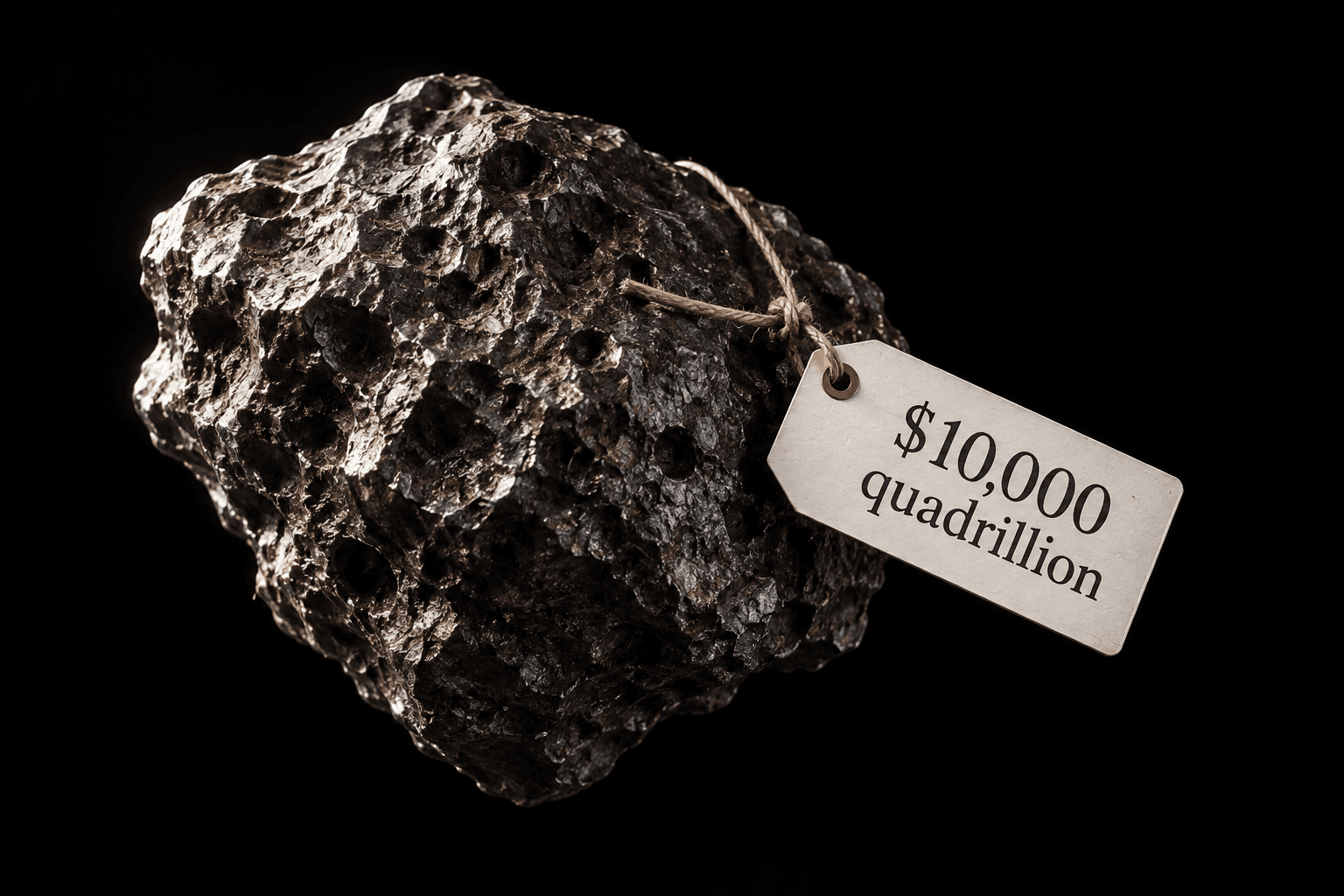
There's a rock between Mars and Jupiter that is supposedly worth $10,000 quadrillion. That's roughly 100,000 times the size of the entire world economy. NASA has a spacecraft on its way there right now.
The scientist who came up with the number has a blunt view of it. She calls it "meaningless in every way."
She's right. The reason she's right is one of the clearest lessons in scarcity you'll find.
The short answer: an asteroid could only make gold worthless if we could bring its metal back cheaply, and we can't. Gold is valuable because it's hard to get more of. If that ever changes, the price changes with it. That one idea explains gold, the pound and Bitcoin better than any chart.
The rock worth more than the world
The asteroid is called 16 Psyche. It's about 140 miles across, roughly the distance from London to Sheffield as the crow flies.
Scientists think it's made mostly of iron and nickel, much like Earth's core. One theory is that it's the core of a young planet that broke apart after a series of huge collisions.
NASA's Psyche spacecraft launched on a SpaceX Falcon Heavy on 13 October 2023 and is due to arrive in 2029. It swung past Mars for a gravity boost in May 2026. Once there, it will orbit for about 26 months, mapping the asteroid's surface, gravity and magnetic field.
The mission is about science. NASA wants to learn about asteroids and how rocky planets form. Nobody is bringing the rock home.

Why the number destroys itself
The $10,000 quadrillion figure came from Lindy Elkins-Tanton, who leads the mission. In 2017 she took the metal she thought Psyche contained and priced it at metals market rates. The headline number was for the iron alone.
The problem with that sum is simple. A price only holds while something is hard to get.
Land a mountain of metal on Earth tomorrow and nobody would pay yesterday's price for it. Elkins-Tanton has made the same point: there's no technology to bring Psyche's metal back, and if there were, the flood of supply would make metals nearly worthless. Back in 2017 she even wondered aloud whether anyone who dragged a piece home would have to sit on it and control supply, the way diamond companies do.
So the rock is worth a fortune only as long as nobody can reach it.
All our gold came from space anyway
There's a twist here, and it comes from Bristol.
In 2011, researchers at the University of Bristol published a study in Nature. When Earth formed, almost all its gold and platinum should have sunk to the core with the molten iron. There's enough precious metal down there to coat the planet's surface four metres deep.
So why can we find any at all? The team found evidence that the gold we mine arrived later, on billions of tons of meteorites that hit Earth more than 200 million years after it formed.
In other words, asteroid mining has already happened once. It took a few hundred million years, and nobody had to pay for the fuel.
Gold is scarce because digging is hard
All the gold ever mined adds up to about 219,891 tonnes. Melted into one cube, it would measure roughly 22 metres on each side.
That's not much, but there's plenty more in the ground. The catch is getting it out at a profit.
Scotland learned this the hard way. Cononish, near Tyndrum, was the country's first commercial gold mine, and gold wasn't even discovered there until the 1980s. It poured its first gold in December 2020 and reached commercial production in July 2022. By March 2023, gold grades in one of its main ore drives had fallen sharply. In November 2023 the company appointed administrators.
The gold was real. Getting it out cost more than it was worth.

That cost is what keeps gold scarce, and it barely moves. In 2025 the gold price set 53 record highs and rose 67% in dollars. Mine output rose just 1%, to 3,672 tonnes, and recycling rose 3%. The World Gold Council says mine production has grown by less than 1% a year on average over the past decade, and output is hard to raise quickly.
Over longer periods, gold does respond. The World Gold Council's own research says new technology and a high enough gold price should unlock supply that's currently too expensive to mine.
That's gold's weak spot. Its scarcity depends on how hard it is to dig up, so if digging gets cheaper, supply grows.
The start-up trying to mine the sky
That brings us back to space. AstroForge, a California start-up, wants to mine platinum-group metals from metal-rich asteroids. Its deep-space probe, Odin, launched in February 2025 and soon ran into serious communication problems, possibly tumbling through deep space.
It's trying again. Its chief executive, Matt Gialich, says the next mission is scheduled for the last quarter of this year and will cost under $10.5 million, including the launch.
Nobody knows if it will work. This is the risk every metal carries: a better drill, a richer seam or a working rocket can change how much of it exists.
Where Bitcoin comes in
Bitcoin was built to avoid gold's weak spot. There will only ever be 21 million, released on a fixed schedule of about 450 a day. When miners add more machines, the network makes the puzzle harder, so extra effort never produces extra coins. A better drill or a working rocket can't change that.
Its supply is predictable. Its price is another matter: Bitcoin swings hard and can fall sharply, and this is education, not financial advice. If you're new to it, our WTF is Bitcoin guide covers the basics.
What the asteroid really teaches us
Psyche will arrive in 2029 and tell us something remarkable about how planets are made. It won't crash the gold price.
That giant number is still useful, though. It shows that value comes from how hard it is to get more of something. For gold, the limit is effort. For Bitcoin, the limit is the rules.
Want more stories like this? Join thousands of UK readers on The Bitcoin Collective newsletter.
Frequently asked questions
Is the Psyche asteroid really worth $10,000 quadrillion?
Only on paper. The figure prices Psyche's metal at 2017 market rates. The mission's lead scientist says it's essentially meaningless, because there's no technology to bring the metal back, and a flood of supply would wreck the market anyway.
Is there gold in asteroids?
Metal-rich asteroids are thought to hold precious metals, which is why companies like AstroForge are targeting them. Much of the gold we mine on Earth is thought to have arrived on meteorites long ago.
Would asteroid mining crash the price of gold?
If metal could be brought back cheaply and in bulk, prices would likely fall. That's a long way off. Even on Earth, gold supply is slow to react: in 2025 the dollar price rose 67% while mine output rose 1%.
Is Bitcoin scarcer than gold?
Bitcoin's total supply is capped at 21 million, and it's growing more slowly than gold's each year. Gold's future supply depends on price and technology. That doesn't make Bitcoin a safer investment, because its price is far more volatile.
Jordan Walker is the founder of The Bitcoin Collective and the Bitcoin Business Network. He organised the UK's first Bitcoin-only conference, hosts The Bitcoin Collective podcast, and writes the weekly newsletter read by thousands of UK professionals.
About

Featured Posts


Explore Topics


Related Post

An honest guide to the best Bitcoin podcasts in 2026, sorted by what you actually want, beginner, macro, technical, and the British shows most lists ignore.

Perfect for newcomers eager to start understanding Bitcoin. Our Bitcoin for Beginners guide features easy and relatable YouTube videos.