Britain uses less electricity per person than it did in 1968
A Briton in 1970 sat in a 12°C living room watching black-and-white telly, and still used more electricity than you do. Here is where it all went, and why the empty corner of one chart should worry us more than the fall itself.

Jordan Walker

In 1970, the average British home sat at around 12°C through the winter. Three in four had no central heating. Colour television had only reached BBC1 and ITV a few months earlier, and most people were still watching in black and white.
That person, shivering in a cardigan in front of a monochrome set, used more electricity than you do.
The UK generated about 4,300 kilowatt hours of electricity per person in 1968. In 2003 the figure peaked at roughly 6,700. Today it is back to about 4,200, a fall of more than a third from the peak and lower than the late 1960s. Those are the figures from Our World in Data, drawn from the Department for Energy Security and Net Zero and the think tank Ember.
Over the same stretch of this century, electricity generation per person across the world rose by more than 50%. Britain went the other way.

Where did all the electricity go?
The easy answer is that the factories closed. That is part of it. International Energy Agency figures show electricity use by UK industry has fallen by a quarter since 2005.
Homes and shops cut their use by about the same share over the same period, though, and nobody shut those down. Something else was going on, and a lot of it was happening in the ceiling.
A standard incandescent bulb draws 60 watts. The LED that replaced it draws around 9. Multiply that across every lamp in roughly 28 million homes, add a fridge that sips where its 1990s ancestor gulped, and the demand just disappears. The EU began phasing out incandescent bulbs in 2009; the UK banned most halogens in 2021.
There is a second, less comfortable reason the generation number fell. We buy more of our electricity from abroad. Net imports covered 1% of UK demand in 2010. By 2025 that was 9%, carried under the sea from France, Norway, the Netherlands, Belgium and Denmark. Some of the electricity we use is still being generated; it is just being generated by someone else.
What we pay for the privilege
Using less has not made it cheaper. In 2024 the UK had the highest industrial electricity price of every country reporting to the International Energy Agency, according to Department for Energy Security and Net Zero figures. A Parliamentary committee put it at around four times the price paid in the United States and Canada. Households sit near the top of the same table.
The reason is how the price is set. For most hours of the day, the last power station switched on to meet demand is a gas plant, and under the UK's market design that plant sets the price for every unit sold in that hour, including the wind and nuclear that cost almost nothing to run. When gas is expensive, as it has been since 2021, everything is expensive.
On top of the wholesale price sit network charges for the wires and policy costs that fund past renewable subsidies, plus the cost of keeping the grid balanced minute to minute. More on that last one shortly.
So Britain has arrived at an odd place. We use less electricity than our grandparents did, pay more for it than almost anyone, and still cannot get all of it to where it is needed.
Is using less electricity a good thing?
Using less to do the same job is a good thing. A warm house that costs less to run is progress by any measure, and the UK's 12°C living rooms of 1970 were not a golden age.
The trouble is what the second chart shows.
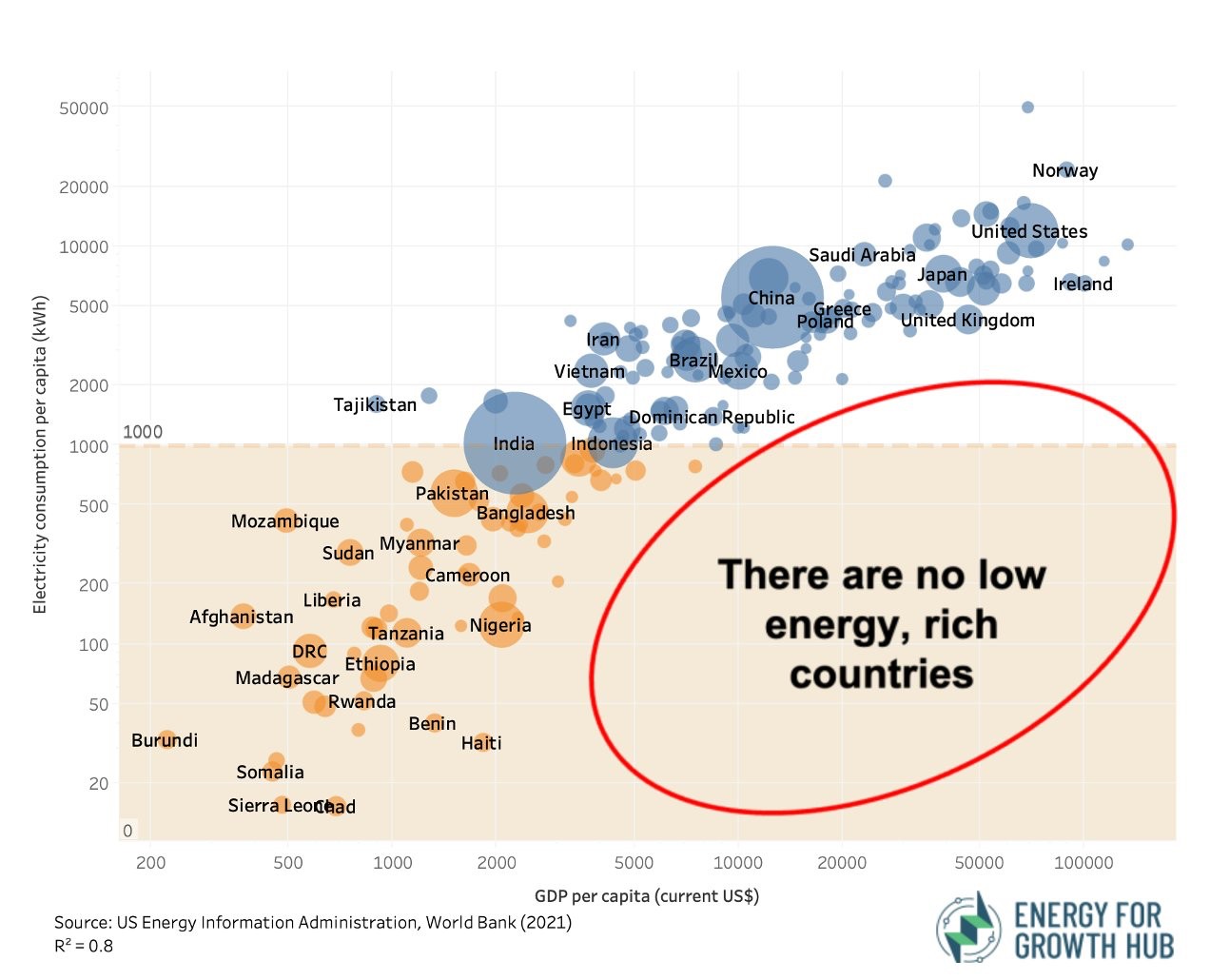
The Energy for Growth Hub, a Washington think tank, plotted every country's electricity consumption per person against its income per person. The pattern is close to a straight line. Below 1,000 kWh a year, every country is poor. Above it, nearly every country is rich. The bottom-right corner of the chart, where low electricity use would meet high income, is empty. Their caption: there are no low-energy, rich countries.
Britain is still comfortably in the rich, high-energy cluster, next to Japan and Poland. Norway sits at the very top, using more than five times as much per person as we do, almost all of it hydro, and it now sells us its surplus through a cable under the North Sea. We are, however, the only large economy sliding down the line rather than up it. The things that are supposed to come next, electric cars, heat pumps, data centres, AI, all run on electricity. Every forecast from the National Energy System Operator has demand rising sharply from here.
So the question is whether Britain can build generation again. And the evidence from the last few years is that we are already struggling to use the generation we have.
The queue to plug in
Anyone who wants to build a power station, a battery or a factory in Britain finds the same thing waiting for them: a queue. At the end of 2024, projects totalling 739 gigawatts were waiting for a grid connection, according to the National Energy System Operator. That was roughly four times what the country is expected to need by 2030. A project joining the back of the queue could expect a connection date in the late 2030s.
Much of it was never going to be built. Applying was cheap and early applicants kept their place, so the list filled with what the industry calls zombie projects: 240 GW of batteries and 210 GW of solar, on paper, for a country that draws around 60 GW on its busiest winter evening. In 2025 NESO scrapped first come, first served, reordered the queue by readiness and need, and cut it to around 283 GW of generation and storage plus 99 GW of demand. Ofgem later found the reform had missed its deadlines and sent out inaccurate offers along the way.
That is the shape of the problem. Demand is about to rise. Hundreds of gigawatts of supply want to connect. Between them sits a grid that takes a decade to say yes, and that already pays to switch off what it has.
The wind we throw away
In 2025, wind farms in Great Britain were told to switch off for the equivalent of around 10 terawatt hours of electricity, according to the energy analysts Montel. Generators were paid £363 million to do it.
The reason is a bottleneck. Most of the UK's new wind power is in Scotland. Most of the demand is in England. The cables between them, known in the industry as the B6 boundary, cannot carry everything the turbines produce on a windy night. So the National Energy System Operator pays Scottish wind farms to stop and pays gas plants in England to start. The combined bill for managing those constraints came to £1.7 billion in the 2024/25 financial year, according to NESO, and it lands on your bill as a line called balancing costs.
We are, in other words, a country that generates less per person than in 1968 and still manages to waste a large chunk of what we do generate, because it is in the wrong place at the wrong time.
Where Bitcoin comes in
There is one industry whose entire business model is turning electricity nobody else wants into something valuable, and switching off the moment somebody else does want it.
Bitcoin mining is the process that secures the Bitcoin network. Warehouses of specialised computers run constantly, and the people running them are paid in Bitcoin for the work. Electricity is their main cost, usually well over half of it, which means they go wherever power is cheapest. That tends to be where it is stranded: hydro dams in Norway, gas fields in West Texas, wind farms with no cable to the city.
The part that matters for a grid is how fast they can stop. A steel mill or a data centre cannot drop its demand on command. A Bitcoin miner can cut to zero in seconds and lose nothing except that hour's revenue. In December 2022, the Texas grid operator ERCOT created a formal programme letting large flexible customers, naming Bitcoin mining facilities specifically, power down during peak demand in exchange for payment. In August 2023, during a heatwave, the miner Riot Platforms reported earning $31.7 million in a single month from selling its contracted power back to the grid and from ERCOT's demand response programme, more than three times what it earned from the Bitcoin it mined.
A UK company is now trying to bring that model here. RenewaBlox builds modular, containerised data centres that sit beside a wind farm, solar site or anaerobic digester and switch on only when the generator has power it cannot sell. The site pays the generator for electricity that would otherwise be curtailed, and the waste heat from the computers goes to whatever is nearby: a greenhouse, a fish farm, a distillery, a swimming pool. Its founders say flexible compute of this kind has been proven abroad and has not yet been deployed in Britain. If that changes, Scotland is where you would expect it to happen first, because that is where the surplus is.
None of that makes Bitcoin a safe bet. Mining is a brutal business with thin margins, and the price of Bitcoin can halve in a bad year, which is why miners chase the cheapest power on earth.
A country that uses less energy is not automatically a country in decline. A country that cannot find a use for the energy it already has is a different problem, and that one has a solution sitting in plain sight.
This piece is about what the technology does to an electricity grid, not whether anyone should buy any. It is education, not financial advice. If you want to understand the machine behind all this, start with our beginner's guide. And if you want one email a week on where Bitcoin meets the UK economy, the newsletter is free.
FAQ
Why has electricity use in the UK fallen? Three reasons, roughly equal in weight. Heavy industry shrank. Homes and businesses became far more efficient, particularly lighting and appliances. And the UK now imports about 9% of its electricity, so some generation moved abroad.
Does the UK import electricity? Yes. Net imports rose from 1% of demand in 2010 to 9% in 2025, through undersea cables to France, Norway, the Netherlands, Belgium and Denmark.
Why are wind farms paid to switch off? The grid cannot always carry Scottish wind power south to where it is needed. When that happens, the system operator pays the wind farm to reduce output and pays other generators, usually gas, to replace it.
Does Bitcoin mining use a lot of electricity? Yes, in total. The relevant question for a grid is when and where it is used. Miners seek out the cheapest, most stranded power and can switch off in seconds, which is why grid operators in Texas pay them to do so at peak times.
Jordan Walker is the founder of The Bitcoin Collective and the Bitcoin Business Network. He organised the UK's first Bitcoin-only conference, hosts The Bitcoin Collective podcast, and writes the weekly newsletter read by thousands of UK professionals.
This article is for education and general information only. It is not financial, investment or tax advice, and nothing in it is a recommendation to buy, sell or hold Bitcoin or any other asset. Bitcoin is volatile and you could lose the money you put in. If you are considering any investment, speak to a regulated financial adviser.
About

Featured Posts


Explore Topics


Related Post

It takes 600 dead phones to make one gold ring. Inside the Royal Mint's plan to outlive the death of the coin.

