WTF is Bitcoin?
So you've heard of Bitcoin, or your annoying friend won't shut up about it, and you've no clue where to start. We've curated the killer list, easy to consume, not a snooze fest.
Not an extensive list, that's entirely on purpose.
Start with this 6-minute video.
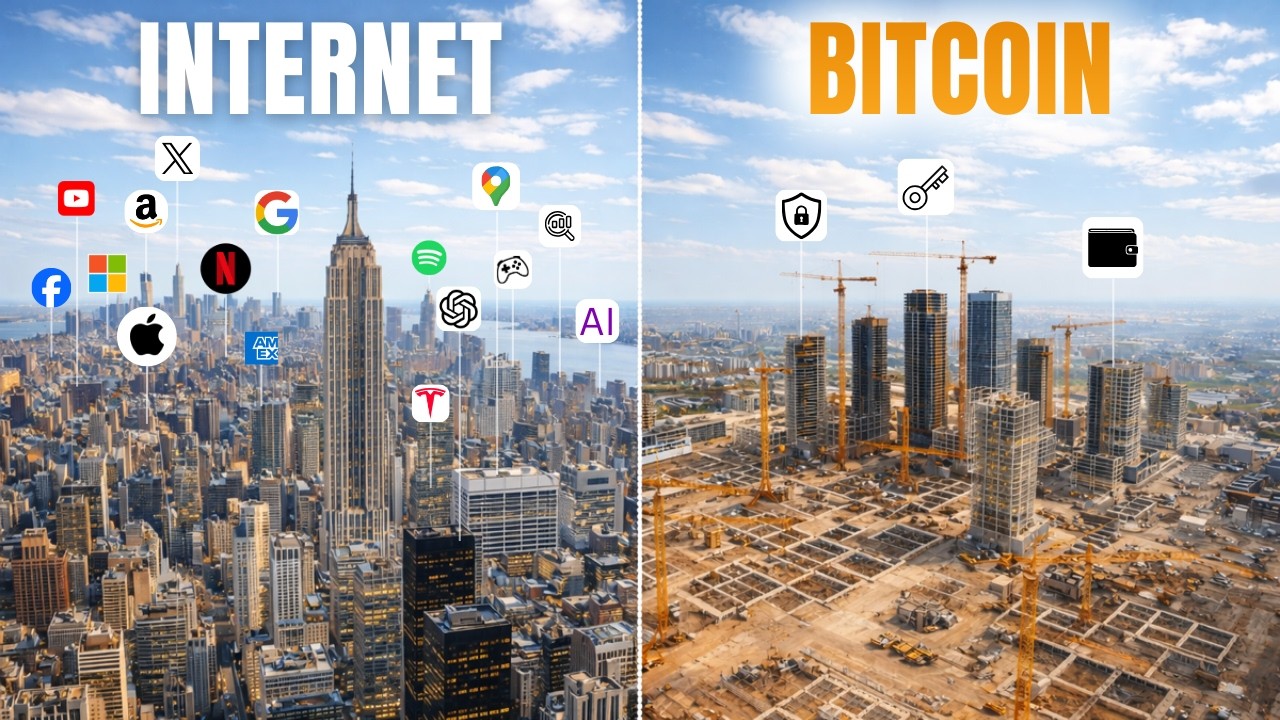
Right, so what actually is it?
It's money nobody controls
Bitcoin is digital money that runs across a network of computers rather than through a bank. No company owns it, no government issues it, and nobody can freeze it or quietly make more of it. There will only ever be 21 million, and that limit was written into the rules on day one. You can own a tiny fraction, send it to anyone in the world, and hold it yourself without asking permission from anyone.
How it actually works
Picture a shared notebook that everyone can read and nobody can erase. Roughly every ten minutes a new page of transactions is added, and thousands of computers around the world check that page independently. Adding a page costs real electricity, which is precisely what makes rewriting the past prohibitively expensive. That cost is the security. You do not need to follow the maths to use Bitcoin, any more than you need to understand how email gets routed in order to send one.
Why it exists at all
Bitcoin launched in January 2009, in the wreckage of the banking crisis, created by someone using the name Satoshi Nakamoto. The very first block has a line of text buried in it: a headline from The Times of 3 January 2009, reading 'Chancellor on brink of second bailout for banks'. That was the point being made. The problem Bitcoin set out to solve is an old one, money that nobody can quietly make more of. The pound has lost the overwhelming majority of its purchasing power within living memory, not through conspiracy, but because more of it keeps being created.
But what about…
The six things everyone raises, answered properly rather than defensively. Some of them are fair criticisms, and we'll say so where they are.
Isn't it just used by criminals?
Cash remains the criminal's tool of choice, because it is genuinely anonymous and leaves no record. Bitcoin's ledger is public and permanent, so every transaction is traceable forever, which makes it a poor place to hide. Criminals have worked this out: Chainalysis found Bitcoin's share of illicit transaction volume fell from around 70% in 2020 to roughly 7% in 2025, as they moved to other assets. Illicit activity accounts for under 1% of all digital-asset transaction volume. Some people do use it badly, as they do with cash and email. That is an argument about people rather than technology.
Isn't it terrible for the environment?
Bitcoin does use a lot of electricity, and there is no point pretending otherwise. Cambridge researchers put the network at roughly 0.5% of global electricity use. Where that power comes from has shifted a great deal, though. The same Cambridge study found sustainable sources at 52.4% of Bitcoin mining in 2025, up from 37.6% in 2022, with coal falling from 36.6% to 8.9%. Natural gas is now the single biggest source at 38.2%, so this is genuinely better rather than solved. Miners chase the cheapest power, which tends to be power nobody else wants. This Machine Greens, further down this page, covers the argument in both directions.
Haven't I missed it?
People have been saying exactly that at every price since it cost a few pence. Nobody honest can tell you where it goes from here, and anyone who claims they can should be ignored on principle. What we can say is that it remains small next to gold, property or the bond market, and that you can buy a few pounds' worth rather than a whole one. Whether that is interesting to you is your call, not ours.
Isn't it just a bubble?
It has crashed hard, repeatedly, and recovered each time over a period of years. That is unusual for a bubble, which tends to pop once and stay popped. It has also run continuously since 2009, and the network itself has never been broken. None of which guarantees anything about the future. The value can fall a very long way, and you should never put in money you need.
What if the government bans it?
Several have tried, with limited success, because there is no company to shut down and no office to raid. The network runs on thousands of independent computers worldwide. The realistic risk is not prohibition but regulation, which is already happening in the UK and elsewhere, and which mostly affects the exchanges you buy through rather than Bitcoin itself.
What if I lose it all?
Two separate risks, worth keeping apart. The price can fall a long way, which is why nobody sensible puts in money they need soon. And you can lose access to your own Bitcoin by losing your keys and your backup, which is a solvable problem and the reason we wrote a whole page about holding it safely. The second risk is entirely within your control.
The one book worth reading first.

Bitcoin: Hard Money You Can't F*ck With
Why a money that nobody issues, controls or can print more of changes things, told as a story rather than a lecture. A shift as big as the internet, in plain readable English. The best first Bitcoin book you will read.
Find it on Amazon →Finished it, or fancy something else? We keep a shelf of eleven Bitcoin books, all of them actually read, sorted from first-timer to deep end.
Three beginner-friendly podcast episodes.
From our own show, chosen because these guests explain things rather than preach them.

When you're ready for more.

Every word you'll trip over, in one place.
Bitcoin has a vocabulary problem. Here's the lot in plain English, so nothing you read next throws you.
Satoshi
The smallest unit of Bitcoin. One Bitcoin is 100 million satoshis, so you can own a very small slice.
Wallet
An app or device that holds the keys to your Bitcoin. The Bitcoin itself lives on the network, not in the wallet.
Private key
The secret that proves the Bitcoin is yours and lets you spend it. Whoever holds the key controls the coins.
Seed phrase
Usually 12 or 24 words that can restore your wallet if the device is lost. Never share it with anyone, ever.
Self-custody
Holding your own keys rather than leaving your Bitcoin sitting with an exchange or an app.
Cold storage
Keeping your keys on a device that never touches the internet, the safest way to hold a meaningful amount.
Exchange
A company that swaps your pounds for Bitcoin. Useful for buying, not designed to be where you leave it.
Blockchain
The shared public record of every Bitcoin transaction, kept in order and checked by the whole network.
Mining
The process of adding new transactions to that record. It costs electricity, and that cost is what secures the network.
The halving
Roughly every four years the rate of new Bitcoin being created is cut in half, which is how the 21 million limit is approached.
Node
A computer running Bitcoin's software and independently checking the rules. Anyone can run one, including you.
Lightning
A layer built on top of Bitcoin for small, instant, very cheap payments, such as buying a coffee.
How not to get scammed.
Beginners are the most targeted people in Bitcoin. Read these six lines once and you'll dodge almost everything.
- Nobody legitimate will message you first about Bitcoin. Not on X, not on Telegram, not on WhatsApp.
- There is no such thing as guaranteed returns. Anyone promising them is lying to you.
- Nobody ever needs your seed phrase. Not support, not an exchange, not us. Anyone asking is stealing from you.
- Any giveaway that requires you to send Bitcoin first is a scam. All of them, without exception.
- Fake support accounts are everywhere. Go to the company's website yourself rather than clicking a link in a message.
- If someone is rushing you, the urgency is the scam. Real opportunities survive you sleeping on them.
Buying it, when you're ready.
Where to buy Bitcoin in the UK
Seven UK platforms compared honestly on fees, funding and whether you can actually withdraw. There's no rush, and no need to buy anything to understand it.
Bitcoin, the beginner questions.
Is Bitcoin legal in the UK?
Yes. It's legal to buy, hold and sell Bitcoin in the UK. It's treated as an asset rather than legal tender, and any exchange serving UK customers has to register with the FCA.
Do I have to buy a whole Bitcoin?
No. A single Bitcoin divides into 100 million tiny units called satoshis, so you can buy a few pounds' worth and own a fraction.
How much do I need to start?
As little as a few pounds. Plenty of people start small with a regular amount rather than a lump sum. What you do is your call, and this page is education, not advice.
What's the difference between Bitcoin and everything else?
Bitcoin came first, and it's the only one with a genuinely fixed supply and no company or founder steering it. The thousands of other digital assets are separate projects with their own teams, aims and risks. We write about Bitcoin and not the rest, and the distinction matters a great deal more than the industry usually admits.
Do I pay tax on Bitcoin in the UK?
Generally yes. HMRC treats Bitcoin as an asset rather than money, so selling it, spending it or swapping it counts as a disposal and can create a capital gains tax bill. The annual exempt amount is £3,000, and the rate depends on your income band. Simply buying and holding is not itself a taxable event, and neither is moving it between your own wallets. Worth knowing: since January 2026, UK platforms have had to collect and report customer data to HMRC. Thresholds change, so check HMRC's current guidance or speak to an accountant about your own position.
Where should I keep it once I've bought it?
Not on the exchange, once the amount matters to you. Moving it to a wallet you control means nobody else can lose it, freeze it, or go bust while holding it. Our guide to holding Bitcoin walks through the options, from a first hardware wallet upwards.
Can I lose my Bitcoin?
Yes, in two ways. Its value can fall sharply, and you can lose access by losing your keys and your backup. The first is a risk you choose to take. The second is avoidable with a written-down backup kept somewhere safe.
Is Bitcoin safe?
The Bitcoin network itself has never been hacked in its entire history. The real risks are its price, which can fall sharply, and losing access to your own coins, which is why backups and self-custody matter.
Can Bitcoin be copied?
The software is open-source, so anyone can copy the code, and plenty have. What can't be copied is the network itself: the years of accumulated computing power, the thousands of independent nodes, and the simple fact that people value it. A photocopy of a twenty pound note has much the same problem.
What happens when all 21 million exist?
The last new Bitcoin is expected around the year 2140, so it isn't a near-term concern. After that, the people securing the network are paid through transaction fees rather than newly created coins.
How do I buy Bitcoin in the UK?
Through a registered exchange. You deposit pounds, buy Bitcoin, and ideally move it to a wallet you control afterwards. Our UK buying guide compares the main options honestly, including the fees that are easy to miss.
So, what now?
You don't have to do anything at all. But if this landed, these are the sensible next steps.
Run a business? The questions are rather different when it's a balance sheet rather than a savings account.
Bitcoin for business →