Why the Royal Mint is mining gold from old laptops
It takes 600 dead phones to make one gold ring. Inside the Royal Mint's plan to outlive the death of the coin.

Jordan Walker

To make one gold ring, the Royal Mint needs 600 dead mobile phones.
Not gold from a vault. Gold from the drawer where old handsets go when their screens crack. The company that has struck Britain's coins for more than 1,100 years now runs a factory in Llantrisant, South Wales, that takes the nation's electronic junk and pulls the gold out of it.
The obvious question is why the maker of the pound coin is doing this. The short answer is that Britain has nearly stopped using coins, so the coin maker went looking for a new seam to work. It found one running through roughly 4,000 tonnes of discarded circuit boards a year.
Nobody is buying the product
In 2015, cash was used for 45% of UK payments. By 2024 that had fallen to 9%, the first year cash dipped below one payment in ten, and UK Finance's latest data puts 2025 at about 8%.
For most manufacturers, demand falling by four fifths would be a crisis. For the Royal Mint it would have been, had it not seen the line on the chart early. In 2024 the Treasury ordered no new 1p or 2p coins at all, on the grounds that the estimated 10.5 billion pennies already out there are plenty. The same thing happened in 2018, the first year without a freshly struck penny since 1972.
The Mint is owned by the Treasury, and its job for over a millennium has been physical money. Its own annual reports describe the Currency division's long-term decline in plain terms, alongside the plan: move into precious metals, collectables and jewellery, and retrain coin makers to run the new lines.
The strangest of those new lines opened in August 2024.
The machine
Lorries deliver circuit boards from across the country. Some arrive via a recycling firm in Preston that dismantles and grades them first, partly in training workshops staffed by serving prisoners. The Ministry of Defence has signed up too, sending electronics stripped from decommissioned kit.
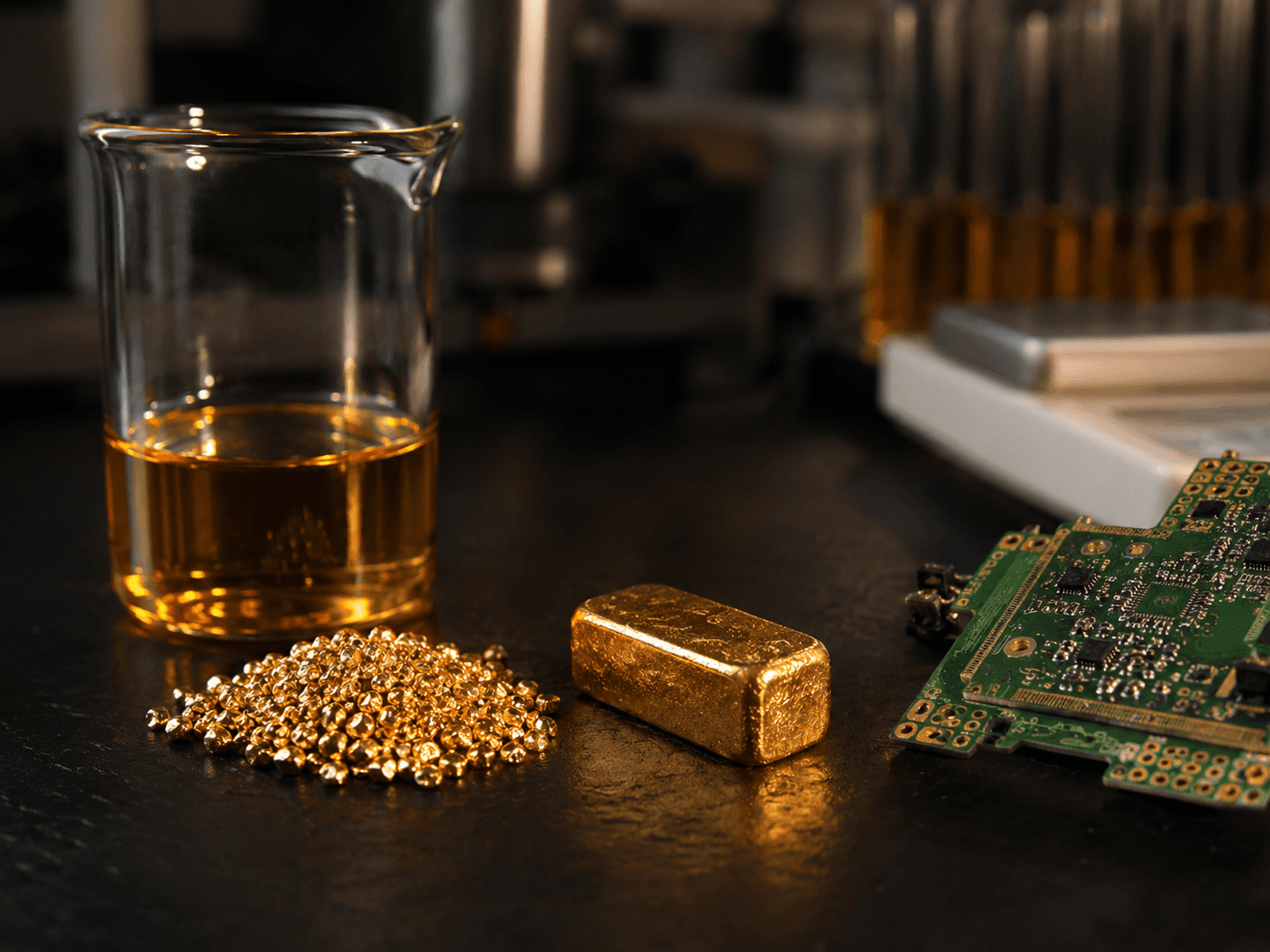
Inside the plant, the boards are heated so their components loosen, then shaken, sieved and sorted along a conveyor. Capacitors go one way, pins and connectors another. Anything carrying gold is set aside and tipped into a chemical bath.
The bath is the clever part. The conventional route is to ship boards abroad and smelt them at high temperature, and the Mint estimates that 99% of Britain's circuit boards used to leave the country exactly that way. Its process, licensed from a Canadian firm called Excir, instead dissolves the gold out at room temperature in minutes and recovers more than 99% of it. The liquid is filtered down to a powder, and the powder is refined to 999.9 purity.
One tonne of circuit boards gives up around 165 grams of gold. A working gold mine is happy with single grams per tonne. The plant can take up to 4,000 tonnes a year, and the Mint expects it to yield hundreds of kilograms of gold annually at full capacity.
Where the gold goes
Onto fingers, mostly. The first destination is 886 by The Royal Mint, a jewellery line named after the Mint's approximate founding year and sold from a shop in London's Burlington Arcade. A 7.5g ring from the range, about the weight of a £1 coin, is those 600 phones from the first sentence. The pieces are struck and pulled using coin-making techniques rather than cast, which is the Mint's way of saying the old skills still matter even if the penny does not. Commemorative coins made from recovered gold are planned to follow.
So the loop closes. Your old Nokia becomes a wedding band, by way of a chemical plant in Wales and, possibly, a workshop in Preston.
Mining without a mine
The Mint's head of sustainability, Inga Doak, has a name for all this: urban mining. She means it literally. An estimated 7% of the world's gold now sits in electronic waste, and the world threw away 62 million tonnes of the stuff in 2022 while recycling less than a fifth. The richest gold deposits in Britain are not under Snowdonia. They are in lofts, landfill and kitchen drawers.
Strip the word mining down to its economics and it means one thing: spending real effort and energy to obtain something genuinely scarce. The Mint spends chemistry, labour and electricity to recover gold because gold is scarce, and nobody can print more of it.
That is also, mechanically, what Bitcoin mining is. Machines around the world spend electricity competing to win coins that are issued on a fixed schedule, with a hard cap of 21 million that no company, mint or government can raise. The scarcity comes from mathematics rather than geology, but the economic logic of the two operations is the same. If that idea is new to you, our beginner's guide WTF is Bitcoin walks through it without the jargon.
And there is a larger signal in the Welsh factory. The institution that made Britain's physical money for eleven centuries has read its own numbers and rebuilt itself around scarce assets rather than circulating cash. Coins are on their way out. What replaces them, for now, is mostly bank deposits moving across card networks. Bitcoin is the other candidate for the job: scarce like the gold coming out of the Llantrisant bath, digital like the contactless taps that made the penny redundant, and mined without a landfill.
Whether it takes that job is not something this article will promise you. Bitcoin's price swings hard, and nothing here is financial advice; this is education, and a story about a coin factory that read the room. But when the Royal Mint itself starts mining, it is fair to ask what money is becoming.
If you want one email a week that follows questions like this, the weekly newsletter is read by thousands of UK professionals.
FAQ
Does the Royal Mint still make coins? Yes. It still produces the UK's circulating coins when the Treasury orders them, along with commemorative and collectable coins and currency for overseas governments. What has changed is the volume: some recent years have seen no new 1p or 2p coins ordered at all.
Are 1p and 2p coins being scrapped? No. The Treasury has said it is not scrapping copper coins and that access to cash is protected in law. It has simply not needed to order new ones in some years, because billions are already in circulation.
How much gold is in a mobile phone? A tiny amount on its own, which is why it takes roughly 600 phones to produce one 7.5g gold ring. Concentrated into a tonne of circuit boards, the gold content reaches around 165 grams, far richer than the ore in a commercial gold mine.
What is 886 by The Royal Mint? The Mint's jewellery brand, named after its approximate founding year, which uses gold recovered from electronic waste. It launched in 2022 and sells online and from Burlington Arcade in London.
About

Featured Posts


Explore Topics


Related Post
A Briton in 1970 sat in a 12°C living room watching black-and-white telly, and still used more electricity than you do. Here is where it all went, and why the empty corner of one chart should worry us more than the fall itself.

