The bank that lends against cheese
An Italian bank has been taking wheels of Parmigiano Reggiano as loan security since 1953, and it has never lost a euro. The reason why explains a lot about whisky casks, warehouses, and what makes anything worth lending against.

Jordan Walker

Somewhere in the hills of Emilia-Romagna, behind barbed wire, a bank vault holds more than half a million wheels of cheese.
Not as a publicity stunt. As collateral.
The bank is Credito Emiliano, known locally as Credem. Since 1953 it has handed cash to dairy farmers in exchange for young wheels of Parmigiano Reggiano. The cheese sits in the bank's own warehouses while it ages. Repay the loan and you get your cheese back. Default and the bank sells it. The stock in those vaults is worth well over €300 million.
It sounds like a novelty. It is actually the clearest lesson in banking you will find anywhere, because it answers a question most of us never think to ask: why will a lender take some things as security and laugh at others?
Why cheese needs a bank in the first place
Parmigiano Reggiano has a cashflow problem baked into it.
A wheel needs at least 12 months to age. Most go 24 or 36. That means two or three years of a small family dairy's money sitting on a shelf doing nothing, while wages, feed bills and vet bills keep arriving every month.
Normally a bank would shrug. Inventory that cannot be sold for three years is not much use to a lender, and a small dairy has little else to pledge.
So Credem took the cheese.
The farmer hands over young wheels and receives 60% to 80% of their value upfront. A Credem subsidiary, Magazzini Generali delle Tagliate, then stores and ages the wheels in two warehouses in Reggio Emilia and Modena. Italy produces roughly 4 million wheels a year and the cheese banks hold about 500,000 of them.
The farmer saves the cost of storage. The bank gets security it can see, touch and value. Both sides win, which is why the arrangement has outlived every banking fashion of the last seventy years.
The part that actually makes it work
Anyone can accept cheese. The hard bit is knowing it is still there and still good.
Cheese is a difficult thing to own. It sweats. It bubbles. It can swell until it cracks, and a cracked wheel is worth a fraction of a clean one. Left alone in a shed, your collateral quietly turns into a write-off.
So Credem built a machine to stop that happening. Climate-controlled warehouses. Stacks twenty wheels high. Trained inspectors who clean, turn and check the stock. At twelve months, an inspector from the Parmigiano Reggiano Consortium walks the racks and strikes each wheel with a small hammer, listening for the hollow note that gives away a flaw inside. Only the wheels that ring true get the fire-branded seal.
The results are hard to argue with. In Credem's warehouses about 1% of wheels degrade enough to be marked down, against an industry average of 10%. Giancarlo Ravanetti, who runs the bank's warehouse business, says the system has operated for more than a century without the bank losing a single euro on these loans.
There is the whole lesson in one line. The cheese did not become good collateral because it was valuable. It became good collateral because someone built an expensive machine to prove it exists and is intact.
What that machine costs to run
The machine is not free, and this year it got dearer.
Europe's record heat pushed daily energy use at the cheese warehouses up by around 30%, forcing upgrades to cooling systems and boilers, more insulation and more on-site renewable generation. Out in the fields the same heat hit the raw material, with cows lying down more and eating less, cutting milk production by as much as 10% a year.
Nature can also simply take the collateral away. When two earthquakes struck Emilia-Romagna in May 2012, the racks came down in dairies and warehouses across the region. Accounts from the recovery describe roughly 600,000 wheels hitting the floor, with a large share never fit to be branded.
The British version has no Credem
Britain does not do cheese banks. It does do something structurally identical, and it is sitting in Scotland right now.
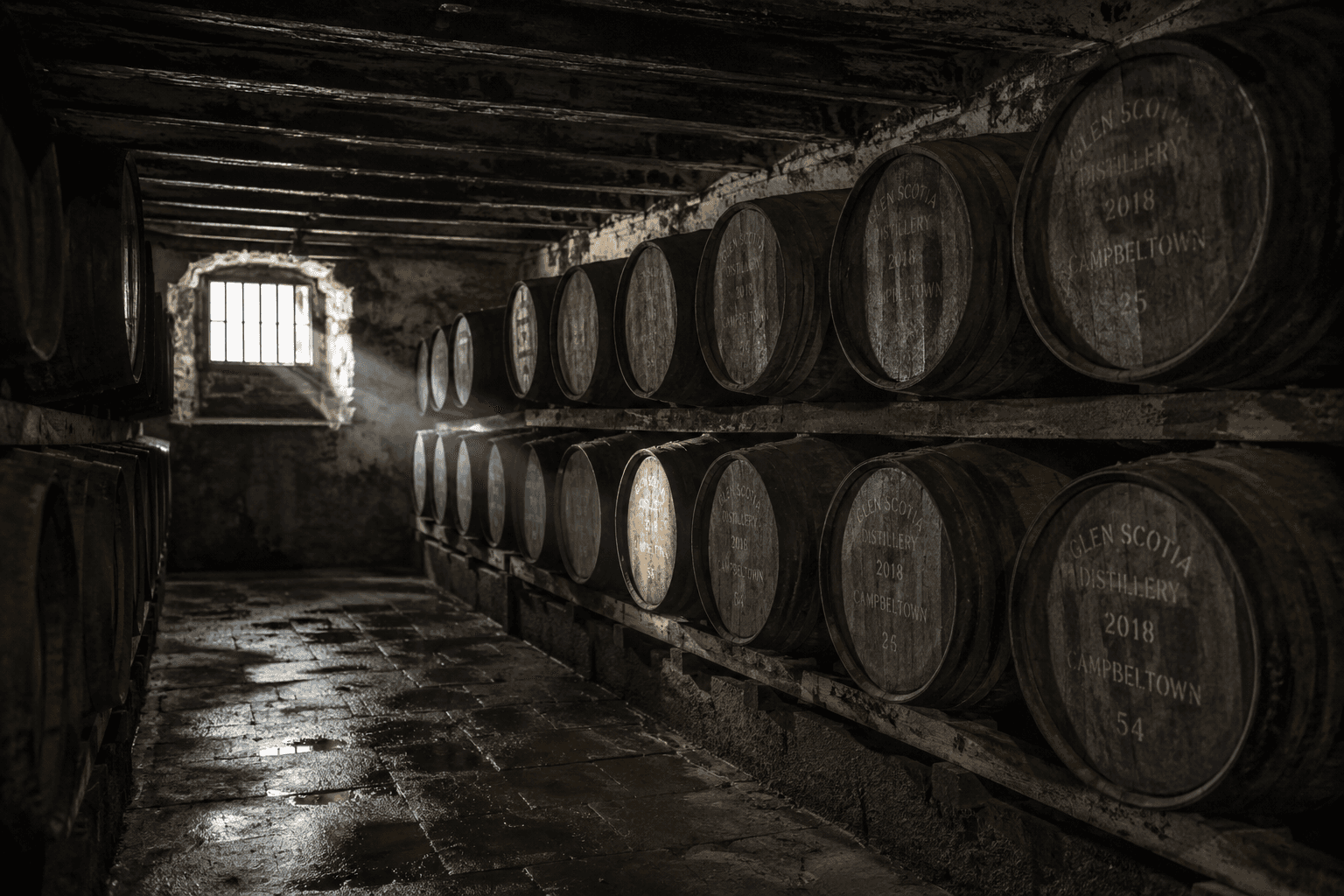
Around 22 million casks of whisky lie maturing in bonded warehouses across Scotland, from 154 working distilleries. Like Parmigiano, whisky is a product that must sit still for years before anyone can sell it. Three years and a day is the legal minimum for Scotch. Many casks wait a decade or more.
Big distillers manage that gap with proper stock finance, backed by audits, delivery orders and warehouse relationships built over decades. They have their own version of the hammer test.
The retail cask buyer usually has none of it.
Whisky casks are not a regulated investment. Buying one is buying tangible property, not a financial product, so it sits outside the FCA's remit, with HMRC involved only for excise purposes. That means no Financial Services Compensation Scheme cover and no route to the Financial Ombudsman if the firm that sold you the cask collapses or turns out to be fictional.
The Advertising Standards Authority has been working through the sector for years. One firm has now been ruled against twice, having traded as London Cask Company, then Caskcap, then Capgroup Int under the same Companies House registration. City of London Police have warned that because casks are sold as long-term holdings, it can be several years before a buyer discovers their investment was never performing, or never existed.
So compare the two positions. An Italian dairy farmer's collateral is inspected by trained staff, tapped with a hammer by an independent consortium and held in a vault the lender owns. A British cask buyer often holds a certificate, an email address and a warehouse they have never set foot in.
Same idea. Completely different level of proof.
What actually makes something good collateral
Strip away the cheese and the whisky and you get a checklist any lender in history would recognise. Good collateral is:
Durable. It survives storage without rotting, cracking or evaporating.
Verifiable. Someone can prove it exists and is intact, cheaply and repeatedly.
Seizable. The lender can actually get hold of it if things go wrong.
Divisible. It can be split into sensible amounts rather than all or nothing.
Liquid. There is a real market that will buy it at a knowable price.
Cheese scores well on four of these and terribly on the first, which is why the vault, the inspectors and the cooling bill exist. Whisky in a cask is the same story with an added problem: for most retail buyers, point two never happens at all.
Where Bitcoin comes in
Run Bitcoin through the same five.
Durability is straightforward, because there is no physical wheel to crack and no spirit to evaporate. Bitcoin does not care about a heatwave in Emilia-Romagna or an earthquake under a warehouse.
Verification is the genuinely interesting one. Bitcoin's entire design is a public record of what exists and who controls it, checkable by anyone running the software on an ordinary computer. What Credem spends millions maintaining, with barbed wire and inspectors and hammers, Bitcoin does as a basic function of the network. Nobody needs to take the warehouse's word for it.
Divisibility and liquidity are easy marks. A Bitcoin splits into a hundred million units, and markets run every hour of every day, which is more than can be said for a cracked wheel or a cask nobody wants.
Then the honest part. Bitcoin's price moves hard and it moves fast, which is exactly what a lender hates. Anyone lending against it applies a heavy discount for that reason, and plenty of people have been badly burned holding it through a drawdown. Nor is there a consortium to appeal to. Holding your own Bitcoin means you are the warehouse, and if you lose the keys there is no inspector coming to help. This is education rather than advice, and none of it is a suggestion to put money anywhere.
But the underlying point survives all of that. For a thousand years, owning something at a distance meant trusting an institution to tell you it was still there. Credem built one of the best of those institutions and it works beautifully, at a cost measured in cooling bills and trained staff.
Bitcoin's proposal is that for one particular kind of property, the institution is optional. You can check for yourself, in seconds, for free.
Whether that is worth anything to you depends entirely on how much you trust your warehouse.
New to this? Start with our plain-English guide, WTF is Bitcoin. If you want to understand the storage side, our where to hold Bitcoin tool walks through the options and the trade-offs of each.
We break down one story like this every week in the newsletter. No hype, no jargon, just the numbers behind the things you already pay for.
Frequently asked questions
Which bank accepts cheese as collateral? Credito Emiliano, known as Credem, a regional bank in Italy's Emilia-Romagna region. It has accepted young wheels of Parmigiano Reggiano as security for loans to local dairies since 1953, and stores them in climate-controlled warehouses run by its subsidiary Magazzini Generali delle Tagliate.
How much can a farmer borrow against a wheel of Parmigiano Reggiano? Producers typically receive 60% to 80% of a wheel's value upfront, with the cheese held and aged by the bank until the loan is repaid.
Are whisky casks a regulated investment in the UK? No. A cask is tangible property rather than a financial product, so it falls outside FCA regulation. There is no Financial Services Compensation Scheme cover and no access to the Financial Ombudsman Service if the seller fails. HMRC's involvement relates to excise duty and approved warehousing, not to protecting buyers.
Can Bitcoin be used as loan collateral? Yes, and a growing number of lenders accept it. Because the price is volatile, lenders typically require significant overcollateralisation, meaning you pledge considerably more than you borrow. Terms vary widely and this is not a recommendation of any particular provider.
What makes something good collateral? Durability, verifiability, the ability for a lender to seize it, divisibility and a liquid market to sell it into. Most disputes about collateral come down to the second one: can anyone actually prove the thing exists and is in good condition?
About

Featured Posts


Explore Topics


