McDonald's is a property company that sells burgers
McDonald's collects around $10 billion a year in rent from its own franchisees, on land it bought decades ago. The burgers were never the business.

Jordan Walker
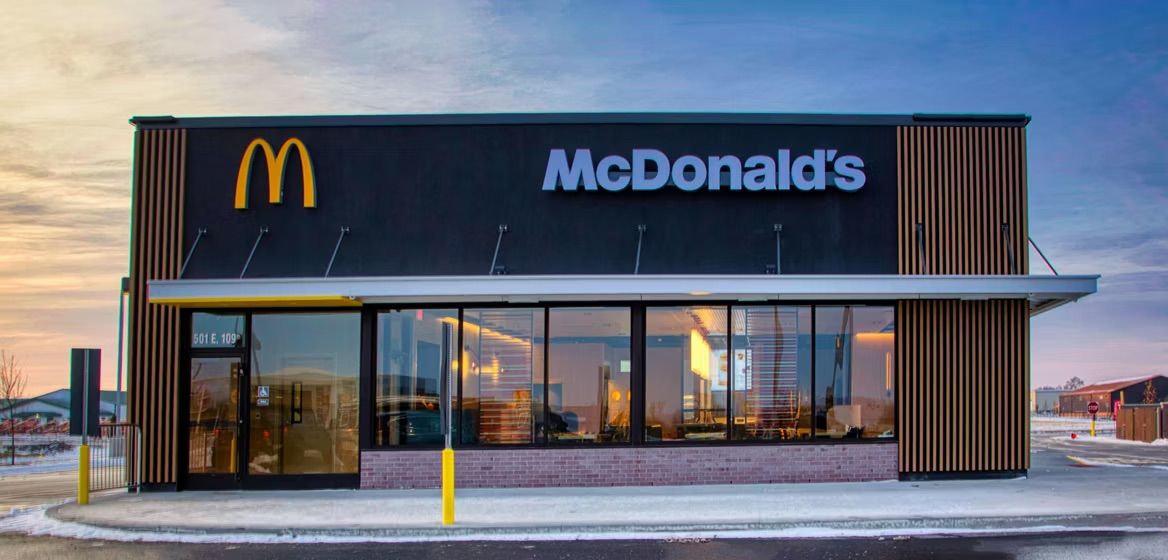
In 1956, a former Tastee-Freez executive named Harry Sonneborn walked into Ray Kroc's fledgling burger operation and told him he had the business the wrong way round.
Kroc thought he was selling franchises. Fifteen-cent hamburgers, milkshake machines, golden arches. Sonneborn saw something else entirely. The franchisees would come and go, the menu would change, but the ground beneath each restaurant would sit there doing the most important work in the company.
So they set up a subsidiary called Franchise Realty Corporation. Instead of just licensing the brand, McDonald's would buy or lease the land and building for each site, then charge the franchisee rent on top of royalties. Sonneborn, who became the company's first president, later put it to a room of investors in words that have followed the company ever since: "We are not technically in the food business. We are in the real estate business."
Seventy years on, that one decision still explains more about McDonald's than anything on the menu.
What McDonald's actually owns
Start with the numbers from the company's own annual report, filed with the US regulator in February 2026.
At the end of 2025 there were 45,356 McDonald's restaurants worldwide, and roughly 95% of them were run by franchisees rather than the company. In its core markets, which cover about 24,500 of those restaurants across the US, UK, Australia and the rest of its directly operated countries, McDonald's owned around 56% of the land and 80% of the buildings outright. Where it doesn't own, it usually holds the long lease and sublets to the franchisee.
The property and other long-lived assets on the books came to $44 billion at the end of 2025. And here is the detail that matters: that figure is recorded at cost. The land is carried at whatever McDonald's paid for it, in some cases half a century ago. A plot bought on the edge of a growing town in 1975 sits in the accounts at its 1975 price. Accounting rules never ask the company to mark it up to what it would fetch today, so nobody outside the company really knows what the estate is worth. Only that it is a lot more than the books say.
How the machine actually works
A conventional McDonald's franchisee signs a 20-year agreement. They pay for the kitchen, the seating, the signs and the fit-out. McDonald's provides the site, because it owns or controls it, and in return the franchisee pays two streams of money: a royalty based on a percentage of sales, and rent.
The rent is the clever part. It has a floor. Franchise agreements specify minimum rent payments regardless of how the restaurant trades, which means McDonald's collects even in a bad year. When sales rise, the rent rises with them, because it is also calculated as a share of turnover.
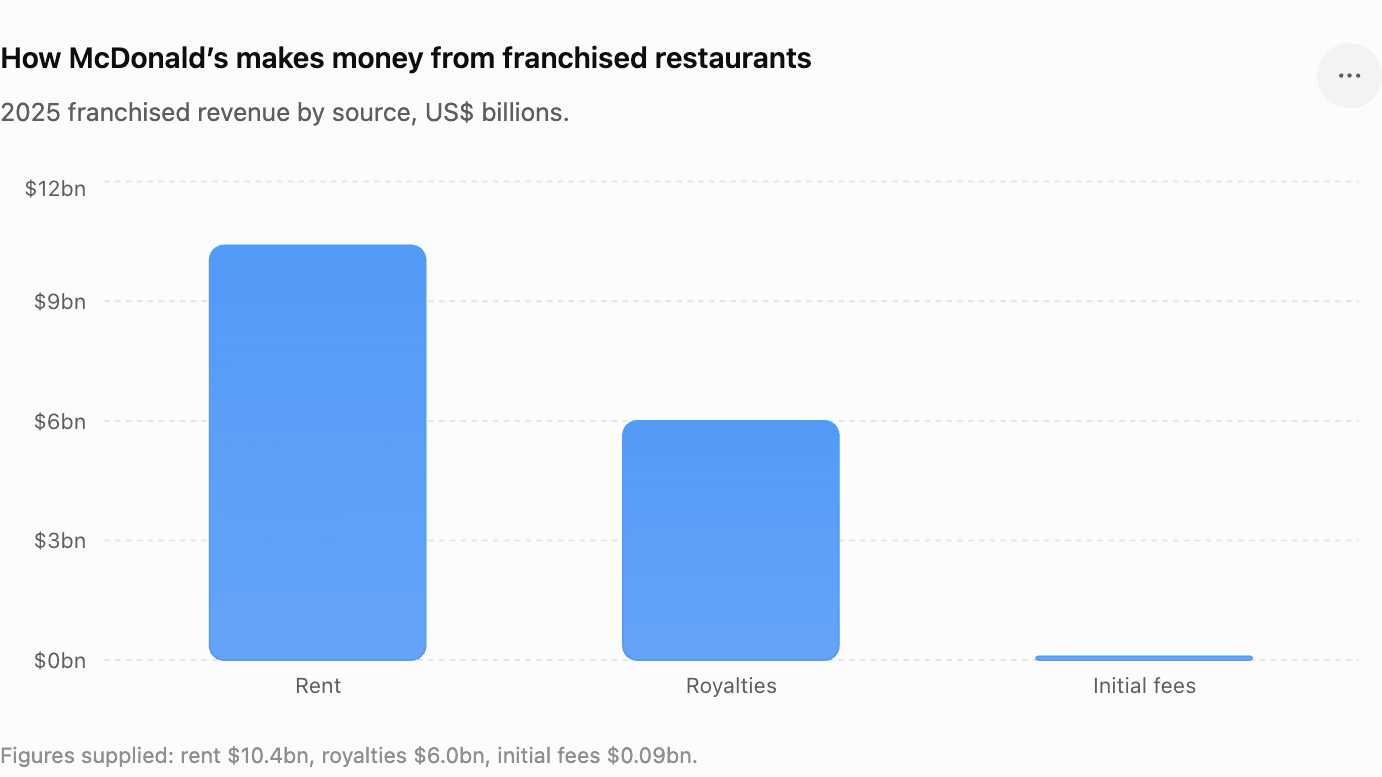
In 2025, McDonald's collected $16.5 billion in fees from franchisees. The single largest component was rent, at $10.4 billion, comfortably ahead of royalties at $6.0 billion. Put another way, rent alone was 39% of everything McDonald's earned last year, from burgers, royalties and all the rest combined. Set against that rental income, the company's occupancy costs were just $2.6 billion, leaving a franchised margin of $13.9 billion, about 84 pence of every pound kept. Company-run restaurants, the ones that actually cook and serve food at scale, earned a margin closer to 15%.
That gap is the whole story. Selling burgers is hard. Beef prices move, wages rise, tastes shift, a bad winter empties the car park. Collecting rent from 20-year tenants on land you bought decades ago is not hard. It is the closest thing in business to gravity.
The quiet sentence in the annual report
Buried in the section on inflation, McDonald's own filing spells it out. The company credits its ability to manage inflationary pressures to its pricing power, its cost controls, and its "substantial property holdings," many of which sit at fixed costs.
Read that again from the other side of the counter. Inflation pushes up the franchisee's wage bill, their energy costs and their cost of beef. But it also pushes up their sales in cash terms, and McDonald's rent is a percentage of those sales. Meanwhile the company's own cost for the land hasn't moved since the day it was bought. Inflation, which punishes anyone holding cash, actively works in McDonald's favour, because the company parked its wealth in something inflation cannot print more of.
That is not an accident. It is the design.
The lesson for every other business
Here is the uncomfortable comparison. Most businesses, including most good ones, only ever build one thing: the earning side. The shop, the agency, the consultancy, the trade. Profits come in, sit in the current account, and buy a little less every year. Over the past five years the pound has lost roughly a quarter of its purchasing power, and a business bank account paying little or nothing did not keep up.
McDonald's built a second thing underneath the first. An asset that does not depend on this year's trading, that cannot be inflated away, and that compounds while the operating business fights the daily fight. When the burger business has a rough year, the land does not care.
Very few businesses ever build that second layer, and for an understandable reason: land is expensive, illiquid and out of reach. The average UK small business cannot buy the freehold under its premises. Commercial property starts at hundreds of thousands of pounds, takes months to transact, and cannot be sold in pieces when cash is tight.
Which is why a growing number of business owners have started asking a different question: what is the accessible version of the land under the restaurant?
The second thing, sized for a normal business
Bitcoin is one serious answer to that question, and it is worth being precise about why, and about the ways it differs from a plot in Ohio.
Like land, Bitcoin's supply cannot be expanded to meet demand. There will only ever be 21 million, in the way there is only ever so much ground on a good corner. Like McDonald's land bank, it sits outside the operating business: it is not a debtor, not stock, not a claim on anyone else's promise to pay. And unlike land, it is divisible down to fractions of a penny, can be bought in any amount from £10 upwards, and can be sold on a Tuesday afternoon if the business needs the cash.
The honest differences matter just as much. Land is steady, and Bitcoin is not. Its price has fallen by half or more several times in its history, sometimes within months, and any business holding it has to be able to sit through that without flinching, which in practice means holding only what the business genuinely will not need for years. McDonald's rent cheques arrive whether property prices rise or fall. Bitcoin pays no rent. It is the appreciation layer without the income layer, which makes it a complement to a strong operating business, never a substitute for one.
None of this is financial advice, and this is not a suggestion that any business should copy a $220 billion corporation's balance sheet. It is education, and the education is this: the most durable company in fast food decided seventy years ago that the profits from a hard business should be stored in an asset that a printing press cannot touch. That principle scales down a long way further than most business owners think.
If you run a company and want to think this through properly, our Bitcoin for Business guide walks through how UK businesses actually approach it, from accounting treatment to custody. And if you want to work through it alongside other UK founders and directors doing the same, that conversation happens inside the Bitcoin Business Network.
The burgers were never the business. The burgers were what paid for the land.
FAQ
Does McDonald's really make more money from rent than from food? From franchisees, yes. In 2025 rent came to $10.4 billion against royalties of $6.0 billion, and franchised margins made up roughly 90% of the company's restaurant margin dollars. Sales from company-run restaurants are larger in headline terms but carry far thinner margins.
Who owns the land under a McDonald's restaurant? In its directly operated markets, McDonald's owned about 56% of the land and 80% of the buildings at the end of 2025. For the remainder it typically holds a long lease and sublets to the franchisee. Under developmental licences, common in other countries, the licensee provides the property.
Why does McDonald's carry its property at cost? Standard accounting. Land and buildings are recorded at purchase price, with buildings depreciated over time, and there is no requirement to revalue them to market. The result is that decades of appreciation are invisible in the accounts.
Is Bitcoin a safe way for a business to store value? Bitcoin is volatile. Its price has dropped by half or more several times, so it suits money a business will not need for years, held in sensible size, not working capital. This article is education, not financial advice; any business considering it should take professional advice on tax, accounting and custody.
About

Featured Posts


Explore Topics


Related Post
Every card tap costs the shop about 6p, and Britain's annual bill for accepting payment has doubled in five years. Here is where the money goes, and who set the price.


Emma Storey-Gordon shares why she added bitcoin to her business, and what other founders can learn from her approach to investing.
Bitcoin for UK companies is becoming essential. Learn why your business needs a Bitcoin strategy to stay competitive.